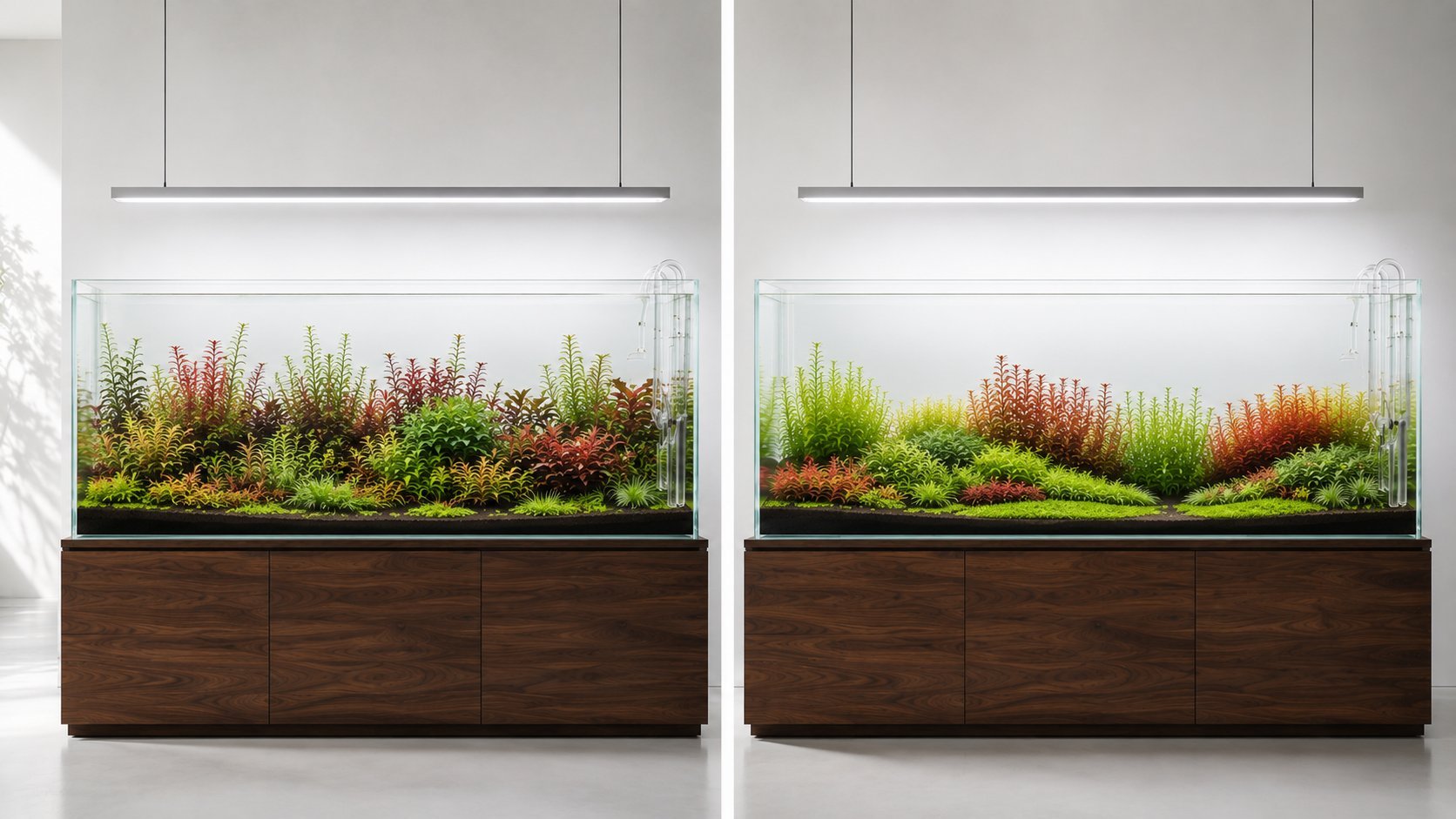
Does your Dutch aquascape feel chaotic instead of elegant? Learn how professional Dutch aquascapers create harmony using plant grouping, repetition, height transitions, and restraint.
Aquascape Oasis Team
Dutch Aquascaping Specialists
The same Dutch aquascape redesigned using classic Dutch aquascaping principles—showing how repetition, plant grouping, and smooth transitions create a calm, harmonious layout.
Ready to explore what a professionally designed Dutch aquascape could look like? See how our luxury design service can help bring balance and beauty to your planted aquarium.
Explore Luxury Design ServicesEvery Dutch aquascaper experiences the same moment.
The plants are healthy. The colors are vibrant. The aquarium is growing exactly as planned.
Yet something still feels... off.
Instead of looking like a carefully designed underwater garden, the aquarium feels busy. Your eyes don't know where to rest. Every plant seems to compete for attention, and despite having beautiful species, the overall composition lacks the quiet confidence you see in award-winning Dutch aquascapes.
It's a frustrating feeling because nothing appears to be wrong.
In reality, the problem usually isn't the plants.
It's the composition.
The most memorable Dutch aquascapes aren't defined by having more species or brighter colors. They're remembered because every part of the aquarium works together, creating rhythm, balance, and movement from one side of the layout to the other.
That's what separates a collection of beautiful plants from a beautiful aquascape.
One of the biggest misconceptions about Dutch aquascaping is that more variety creates more interest.
At first, it seems logical. If one beautiful plant looks good, ten different beautiful plants should look even better.
The opposite often happens.
Every plant has its own leaf shape, texture, color, and growth pattern. When too many of these characteristics compete in the same area, the eye has nowhere to settle. Instead of seeing one harmonious landscape, you begin noticing individual plants fighting for attention.
This is why experienced Dutch aquascapers often work with fewer species than beginners expect.
They aren't limiting creativity.
They're strengthening it.
By repeating plants throughout the layout and allowing each species enough space to make an impact, the aquarium feels intentional rather than crowded.
Luxury gardens follow the same philosophy. A botanical garden rarely plants one of everything. It creates confidence through repetition.
Ready to design with intention? Download the free tank stability checklist →
One of the defining characteristics of exceptional Dutch aquascaping is repetition.
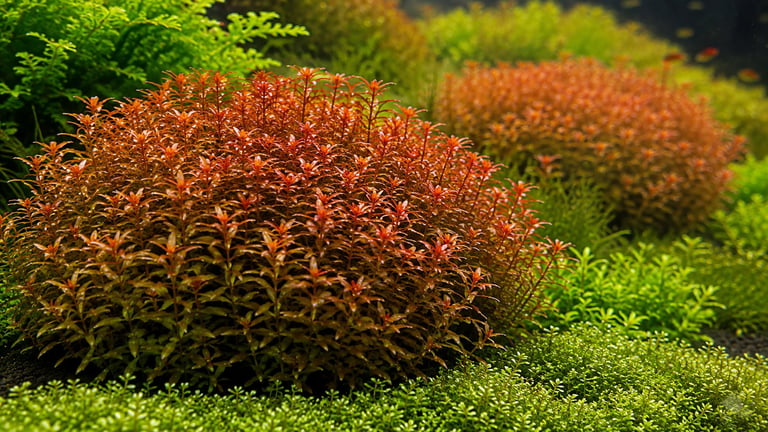
A vibrant group of Rotala appears near the left side of the aquarium, then quietly reappears farther down the layout. Similar textures create visual rhythm while subtle color transitions guide the eye naturally across the aquarium.
Nothing feels random.
Everything feels connected.
Beginners often avoid repeating species because they're afraid the layout will become boring.
Ironically, repetition creates the opposite effect.
It allows every group to feel larger, stronger, and more deliberate. Instead of seeing twenty individual plants, you begin seeing one complete landscape.
That's exactly what makes mature Dutch aquascapes feel so calming.
Want a layout where every detail feels intentional? Explore luxury aquarium design →
Walk through an award-winning Dutch aquarium and you'll notice something surprising.
Every plant seems to know exactly why it's there.
Tall stems establish the background. Medium-height species create smooth transitions. Lower-growing plants soften the foreground. Accent colors appear intentionally rather than everywhere at once.
Nothing feels accidental.
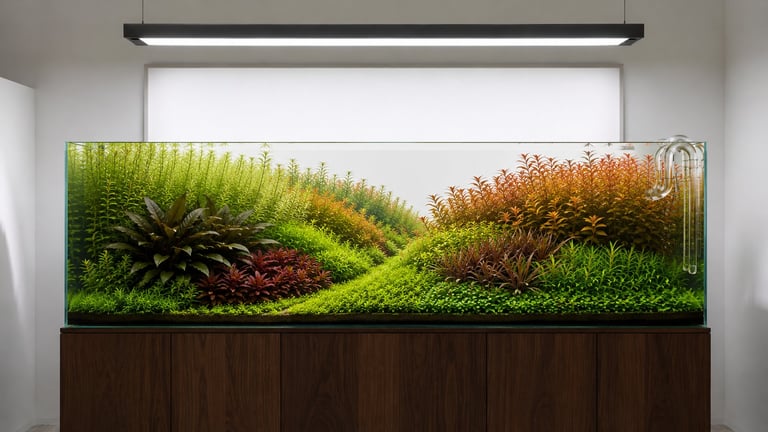
When every new plant is added simply because there's empty space to fill, the layout gradually loses its structure. Beautiful species become visual noise because they no longer contribute to a larger composition.
Before introducing another plant, ask a simple question: What purpose does this species serve?
If the answer isn't immediately clear, the aquarium may not need another plant. It may need more confidence in the plants already there.
One of the easiest ways to recognize a chaotic Dutch aquascape is by watching your own eyes.
Do they jump randomly from one bright plant to another? Or do they naturally flow through the aquarium without effort?
The finest layouts gently guide the viewer through the composition. Plant "streets" create depth. Height transitions feel gradual rather than abrupt. Contrasting leaf textures appear beside one another without becoming overwhelming.
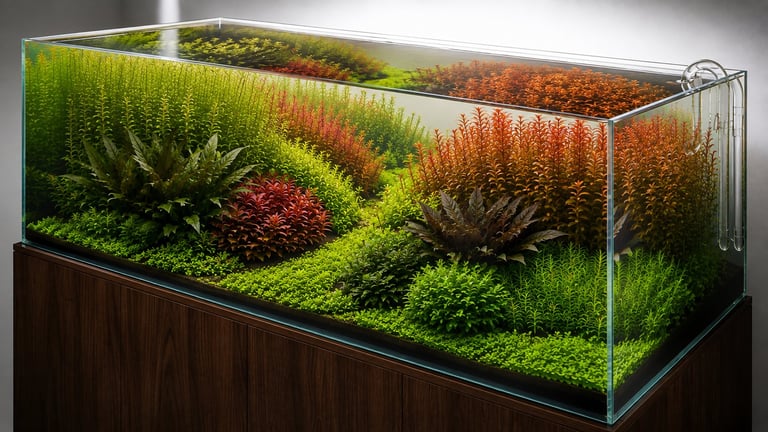
Strong focal areas are supported by quieter sections that give the eye room to rest.
The aquarium becomes a journey rather than a collection.
This quiet movement is one of the reasons Dutch aquascaping has remained timeless for generations. It isn't trying to impress you all at once. It invites you to keep looking.
Learn how professional aquascapers guide the eye through a layout. See luxury design principles in action →
Many aquascapers assume the solution to a chaotic layout is adding another interesting species.
More often, the opposite creates the greatest improvement.
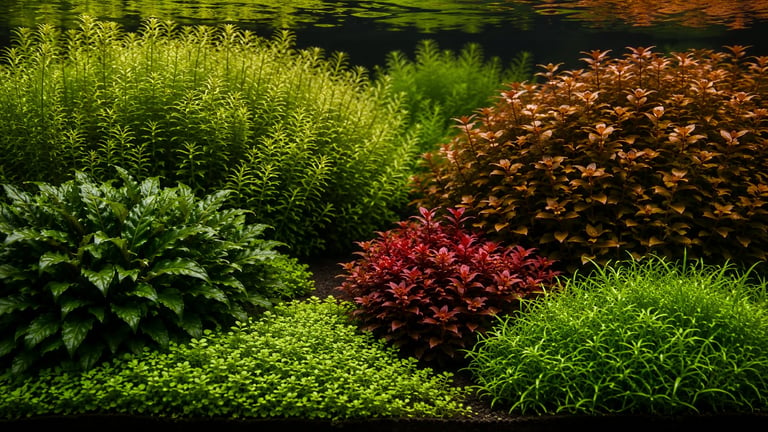
Removing one unnecessary plant group can instantly strengthen the composition. A larger group becomes more dominant. A transition becomes cleaner. Negative space becomes intentional rather than accidental.
Professional designers understand that restraint is one of the most powerful design tools available.
A Dutch aquascape doesn't become elegant by including everything. It becomes elegant by knowing what to leave out.
When people admire a competition-winning Dutch aquarium, they often describe it as natural. Balanced. Peaceful.
Those words aren't accidents.
They're the result of hundreds of small design decisions made with intention rather than impulse. Every repeated species. Every carefully planned transition. Every trimmed stem group. Every empty space that allows another group to breathe.
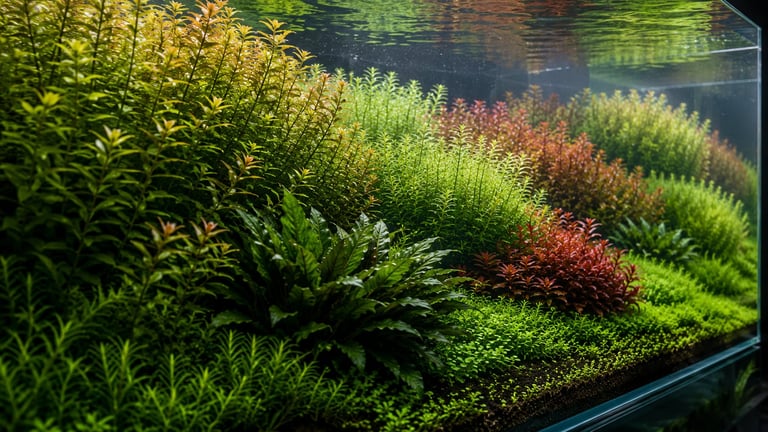
The goal has never been to create the most complicated aquarium.
The goal is to create one that feels effortless.
And that's exactly what separates a beautiful collection of plants from a truly unforgettable Dutch aquascape.
Beautiful aquascapes start with a healthy, stable foundation. Download the free self-sustaining tank stability checklist →
Whether you're designing your first Dutch aquascape or refining an established layout, professional design guidance can help you create a balanced, harmonious aquarium that feels intentionally beautiful — not accidentally busy.
You'll receive: a personalized Dutch aquascape concept, plant grouping recommendations, height transition planning, and design guidance focused on long-term beauty and composition.
Explore Our Luxury Aquarium Design ServicePrefer to start with a free resource? Download the tank stability checklist →
Common questions about fixing a chaotic Dutch aquascape
Beautiful Dutch aquascapes don't happen by accident. They're built on healthy plant growth, consistent maintenance, and long-term stability. Get the free checklist to learn the habits that help planted aquariums grow into lush, balanced landscapes.
No spam. Free resource. Unsubscribe anytime.