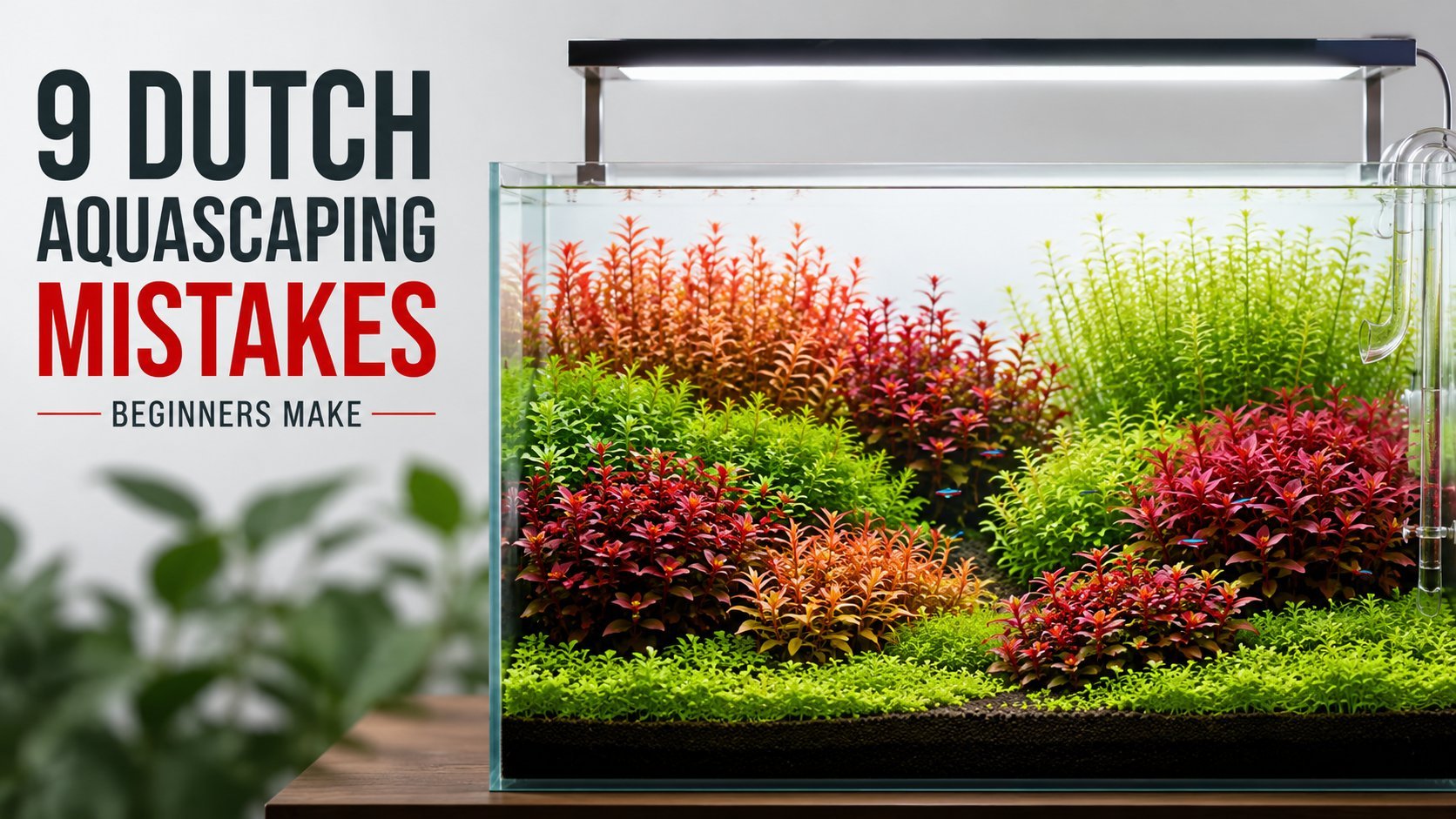
Dutch aquascaping creates some of the most beautiful planted aquariums in the world. But small design mistakes can keep your tank from ever looking the way you imagined. Here are the nine most common ones — and how to avoid them.
Aquascape Oasis Team
Planted Tank Specialists
A vibrant Dutch aquascape illustrating the nine most common mistakes beginners make — and how thoughtful plant selection, grouping, and trimming can transform your aquarium.
Avoid the mistakes that keep Dutch aquascapes from reaching their potential. Download our free self-sustaining aquarium checklist.
Send Me the Free ChecklistDutch aquascaping has a reputation for being one of the most beautiful planted aquarium styles in the world. Towering streets of colorful stem plants, dramatic contrasts, and carefully sculpted layouts create aquariums that resemble underwater botanical gardens.
Yet many beginners discover something frustrating.
They buy beautiful plants, invest in quality equipment, and carefully follow tutorials, but their aquarium never captures the elegance they admired in photographs.
The difference usually isn't experience. It's a handful of small design decisions that compound over time.
If you're building your first Dutch aquascape, avoiding these nine common mistakes will put you far ahead of most beginners.
One of the biggest misconceptions is treating a Dutch aquascape like a Nature Aquarium.
In a Nature Aquarium, stones and driftwood often define the composition. Plants support the hardscape.
Dutch aquascaping reverses that relationship. Plants become the architecture.
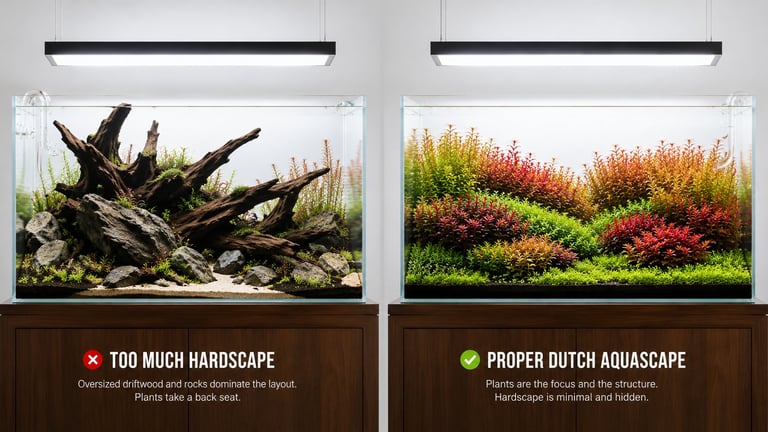
Hardscape should play only a supporting role — if it's visible at all. Many traditional Dutch layouts use little more than small stones hidden beneath the planting to provide structure. Once the plants mature, the hardscape nearly disappears.
If large rocks or dramatic driftwood dominate the aquarium, you've likely drifted away from a true Dutch design.
Instead, let the plants become the centerpiece.
Key Takeaway
In Dutch aquascaping, plants are the architecture. Use hardscape sparingly — let your stem plants define the structure and visual flow of the aquarium.
Want to get your plant selection right from the start? Grab our free aquarium setup checklist →
It's tempting to buy one pot of every beautiful plant at the aquarium store.
The result usually looks more like a collection than a composition.
Dutch aquascapes succeed because they embrace repetition.
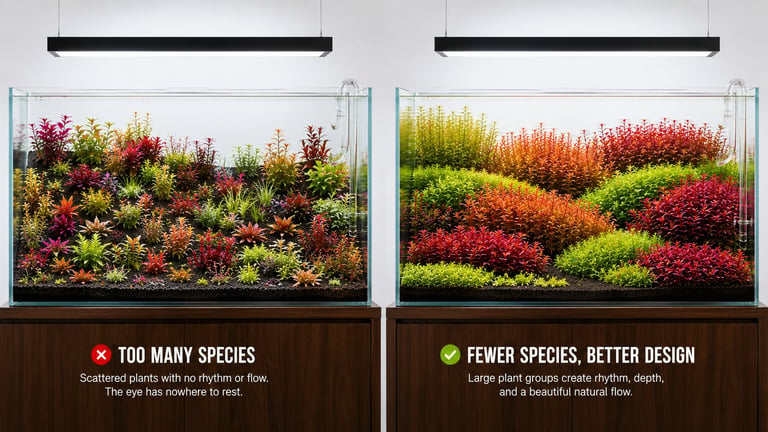
Instead of using twenty different species in tiny amounts, choose fewer species and plant each one in generous groups. Large masses of Rotala, Ludwigia, Hygrophila, and Limnophila create rhythm and visual flow that scattered stems never achieve.
A handful of carefully selected species almost always creates a stronger layout than endless variety.
Key Takeaway
Choose fewer species and plant them in generous groups. Repetition creates rhythm — variety creates chaos.
Great Dutch aquascapes guide your eyes naturally through the aquarium. That doesn't happen by accident.
If every plant reaches the same height, the layout feels flat. If tall plants suddenly sit beside carpeting plants without a transition, the composition feels abrupt.
Instead, think in layers.
Foreground plants lead into medium-height species before gradually transitioning into taller backgrounds. Each group should feel connected to the next.
Like a beautifully landscaped garden, your aquarium should flow naturally rather than jump from one height to another.
Key Takeaway
Layer your plants from short to tall. Smooth height transitions guide the eye naturally through the aquascape and create depth.
Plant streets are one of the defining characteristics of classic Dutch aquascaping.
These are long, uninterrupted groups of the same species that create depth and movement across the aquarium.
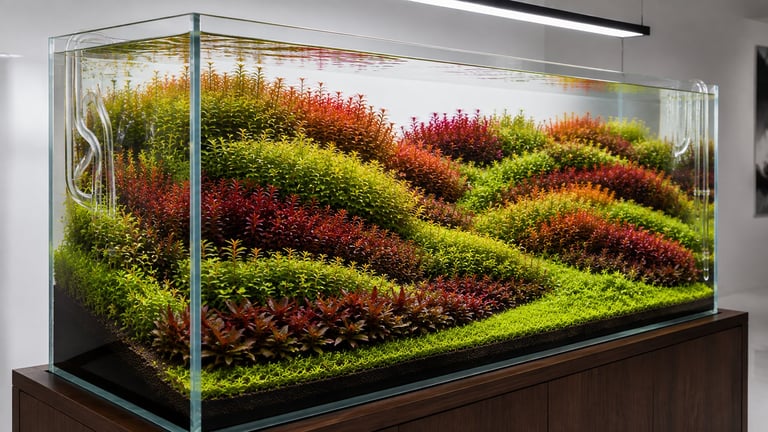
Without them, the layout often feels random.
A street of Rotala extending diagonally toward the back instantly creates perspective. A broad sweep of Ludwigia gives the eye somewhere to travel before moving to the next group.
These repeating lines help organize what could otherwise become visual chaos.
Key Takeaway
Plant streets — long, continuous groups of the same species — create rhythm, depth, and perspective. They're the backbone of Dutch aquascaping.
Building your first Dutch aquascape? Get our free aquarium setup checklist →
Red plants are stunning. That's exactly why they're easy to overuse.
When every group competes for attention, nothing stands out.
Successful Dutch aquascapes use red plants strategically. Bright greens establish the foundation, while carefully placed reds create focal points and contrast.
Think of red as an accent — not the entire palette.
Restraint often creates far more impact than abundance.
Key Takeaway
Use red plants as accents, not the main palette. Green establishes the foundation — red creates the moments of drama.
Every memorable Dutch aquascape has areas that naturally attract your attention.
Without a focal point, viewers don't know where to look.
This doesn't require a dramatic centerpiece. Often it's a striking group of Alternanthera reineckii, a perfectly sculpted red stem group, or a bold contrast between neighboring plant streets.
Once the eye discovers that focal point, it naturally explores the rest of the aquarium.
Key Takeaway
Create at least one clear focal point. A bold red plant group, a striking contrast, or a perfectly sculpted bush gives the eye a place to land.
Get our free guide covering plant selection, layout design, and maintenance schedules.
Download the Free ChecklistA Dutch aquascape isn't finished when you plant it. It's built through trimming.
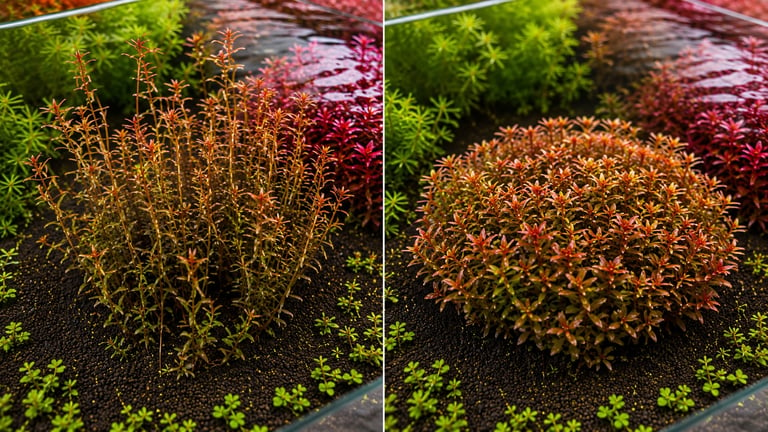
Stem plants become fuller because each trim encourages new branches. Over time, those branches create the dense bushes that define mature Dutch layouts.
Skipping maintenance allows plants to become leggy, blocks light from lower leaves, and destroys the carefully planned composition.
Consistent trimming is what separates a planted aquarium from a Dutch aquascape.
Key Takeaway
Consistent trimming is non-negotiable. Every trim encourages branching, which builds the dense, sculpted bushes that define Dutch aquascapes.
Individual stems almost always look sparse.
Dutch aquascaping relies on groups.
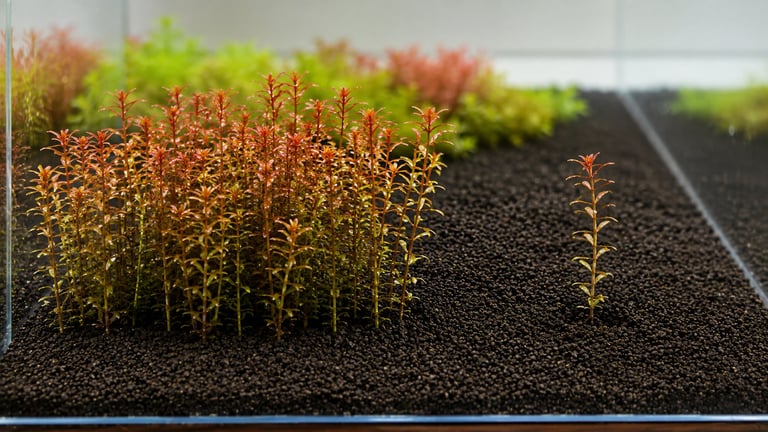
Instead of planting isolated stems throughout the aquarium, create dense clusters of the same species. Even if the plants look small at first, healthy stem plants will branch and fill the available space over time.
One stem becomes two. Two become four.
Those carefully grouped stems eventually become the lush plant masses that give Dutch aquascapes their signature appearance.
Key Takeaway
Always plant in dense groups, not single stems. Clusters fill in over time and create the lush, massed appearance that defines Dutch layouts.
Even the best layout will lose its structure without regular care.
Successful Dutch aquascapes depend on consistency. That means:
Maintenance isn't just about keeping plants alive. It's about preserving the composition you've worked so hard to create.
Small, consistent tasks are far easier than trying to rescue an overgrown aquarium months later.
Key Takeaway
Maintenance preserves your composition. Weekly trimming, stable CO₂, and consistent fertilization keep a Dutch aquascape looking its best.
Need a structured maintenance plan? Our free checklist walks you through it step by step →
Every award-winning Dutch aquarium started exactly where yours will. Freshly planted. Somewhat empty. Far from perfect.
The difference is that experienced aquascapers understand the process. They group plants generously, trim consistently, think in layers, and allow time to transform individual stems into sculpted underwater gardens.
If you focus on avoiding these common mistakes, you'll spend less time fixing problems and more time watching your aquarium mature into the vision you imagined.
Ready to skip the mistakes entirely? Download our free checklist to avoid the nine most common Dutch aquascaping pitfalls, or explore our luxury design service and let us build your dream aquarium for you.
Common questions about Dutch aquascaping mistakes and how to build a thriving planted aquarium.
The main difference is the role of plants versus hardscape. Nature Aquariums (popularized by Takashi Amano) use stones and driftwood as the primary design elements, with plants supporting that structure. Dutch aquascaping reverses this — plants become the architecture, and hardscape plays a minimal supporting role. Many traditional Dutch layouts hide their hardscape entirely beneath the planting.
For beginners, 8–12 species is a good range. The key isn't the number — it's how you plant them. Use large, generous groups of each species rather than scattering individual stems. A layout with 10 species planted in bold groups will look far more impressive than one with 20 species planted in tiny clusters. Focus on repetition and rhythm over variety.
Most Dutch aquascapes benefit from weekly trimming. Fast-growing stem plants like Rotala and Ludwigia may need attention every 5–7 days, while slower species can go 10–14 days. The key is consistency — regular trimming encourages branching and creates the dense, sculpted bushes characteristic of Dutch layouts. Skipping weeks leads to leggy growth and loss of structure.
While it's technically possible to grow stem plants without CO₂, Dutch aquascapes almost always benefit from CO₂ injection. The dense planting, high light requirements, and fast growth rates that define this style demand consistent carbon availability. Pressurized CO₂ systems provide the stability that Dutch layouts need. Without it, plants often grow slowly and may struggle to achieve the lush density that makes this style so beautiful.
Start with hardy stem plants that respond well to trimming: Rotala rotundifolia, Ludwigia repens, Hygrophila polysperma, Limnophila sessiliflora, and Bacopa caroliniana. For contrast, add Alternanthera reineckii for red accents and Staurogyne repens for foreground texture. These species are forgiving, grow well under moderate light with CO₂, and develop the bushy appearance Dutch aquascapes are known for.
Plant streets are long, uninterrupted groups of the same species that create depth and movement. To build them, plant stems in a diagonal or sweeping line from front to back rather than in tight clusters. Leave enough space between streets so each group reads as distinct. A street of Rotala extending diagonally toward the back corner, for example, instantly creates perspective and draws the eye through the aquarium. The best Dutch aquascapes use 3–5 well-defined streets as the backbone of the layout.
Red plants should be used as strategic accents, not the dominant palette. A good guideline is to keep red plants to roughly 15–25% of the total plant mass. Place them at focal points — a striking group of Alternanthera reineckii or a sculpted Ludwigia bush where you want the eye to land first. When everything is red, nothing stands out. Bright greens establish the foundation, and carefully placed reds create the moments of drama that make Dutch aquascapes so memorable.
A freshly planted Dutch aquascape almost always looks sparse — and that's normal. The key is planting in generous, dense groups from the start. Instead of spacing individual stems widely, plant 5–8 stems together in tight clusters. Over time, each stem will branch after trimming, and those clusters will fill in to create the lush appearance you see in mature aquascapes. Also, use foreground, midground, and background layers so the aquarium has depth even before plants fully mature. Patience and consistent trimming are what transform an empty-looking tank into a full Dutch aquascape.
A focal point in a Dutch aquascape doesn't require a dramatic centerpiece. Often it's created through contrast: a bold red plant group surrounded by greens, a particularly sculpted bush at the intersection of two plant streets, or a height variation where tall stems drop suddenly to a low foreground carpet. Position your focal point roughly one-third of the way across the aquarium (following the rule of thirds) rather than dead center. Once the eye discovers that focal point, it naturally explores the rest of the layout through the plant streets and height transitions you've created.
Dutch aquascapes thrive under moderate to high lighting (40–60+ PAR at the substrate). Full-spectrum LED fixtures in the 6500K range work well for most setups and bring out the vibrant greens and reds that define this style. The key is consistency — photoperiods of 7–8 hours with a stable CO₂ supply prevent algae while giving stem plants enough light to grow densely. Avoid overly long photoperiods (10+ hours), which often lead to algae problems. If you're seeing leggy growth or poor coloration, increase light intensity before extending duration.
Continue learning with these guides on Dutch aquascaping, plant care, and aquarium maintenance.
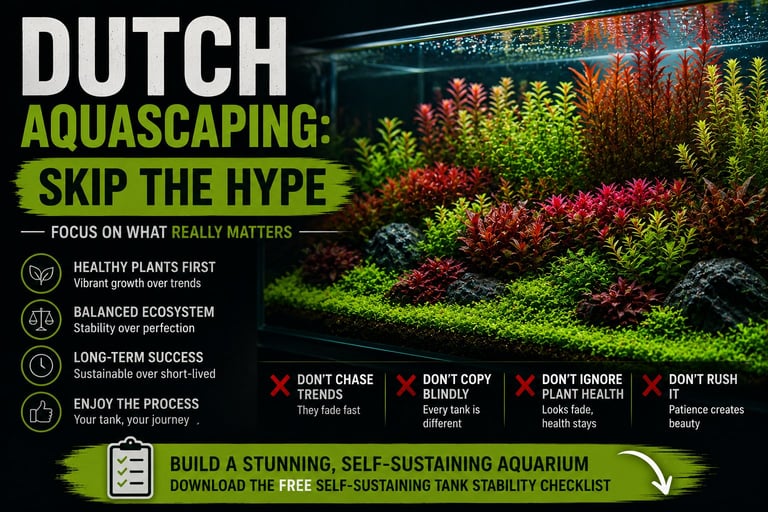
Master the iconic Dutch aquascaping style with our step-by-step guide covering plant selection, placement techniques, and long-term maintenance.
Read Article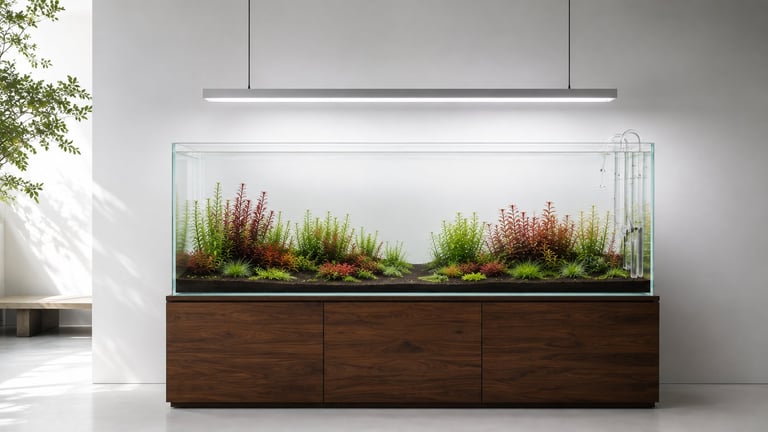
Learn the five most common reasons Dutch aquascapes look empty after planting and how professional aquascapers create lush, dense layouts.
Read Article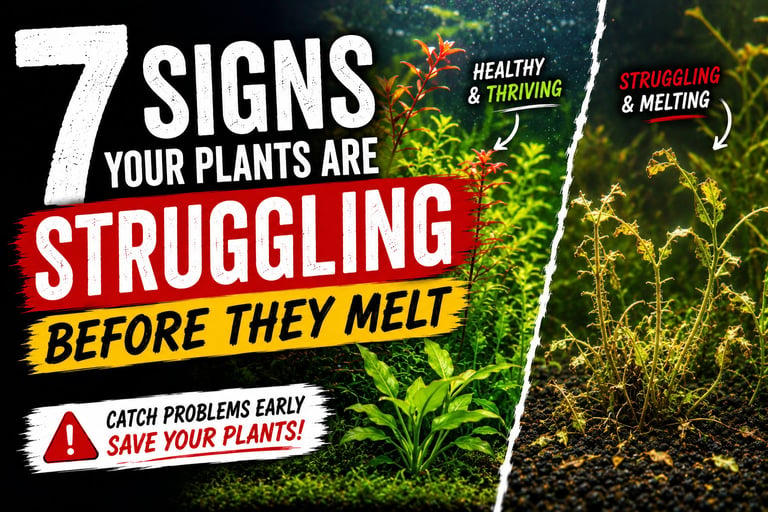
Aquarium plant melt doesn't usually happen overnight. Learn the seven early warning signs and how to correct course before decline.
Read Article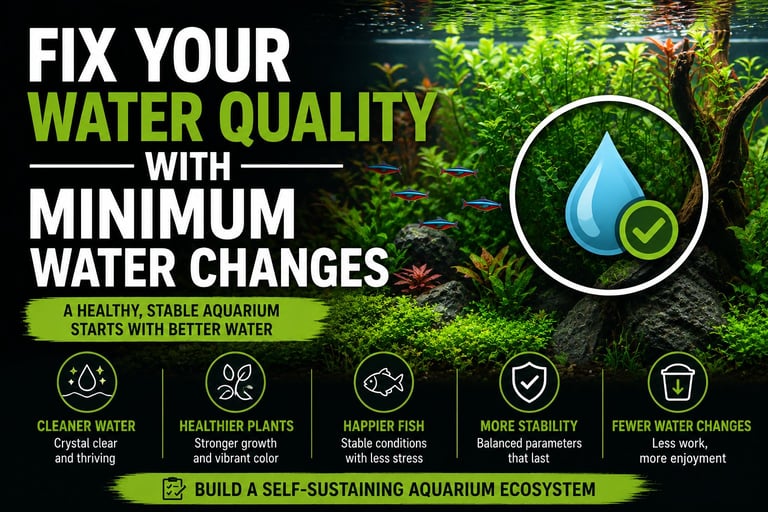
Master biological balance for Dutch aquascapes. Learn how stable ecosystems maintain crystal-clear water with fewer interventions.
Read ArticleAvoid the mistakes that keep Dutch aquascapes from reaching their potential. Get our free checklist covering plant selection, maintenance schedules, water parameters, and the key principles behind stable planted aquariums.
No spam. Unsubscribe anytime.