
Reality
Check
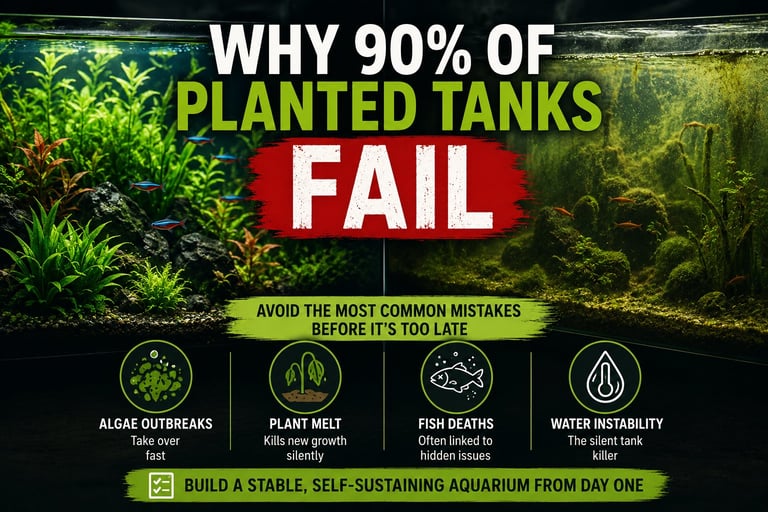
Why 90% of Planted Tanks Fail
The honest truth about why most planted aquariums crash — and the systematic approach that prevents failure before it starts.
Read Article
The truth about plant melt, algae outbreaks, fish deaths, and water instability that catches most new hobbyists off guard — and what you can do differently.
Aquascape Oasis Team
Planted Tank Specialists
Don't let your planted tank become another statistic. Download our free checklist covering the critical setup steps most beginners miss — so your aquarium thrives past the dangerous 90-day mark.
Send Me the ChecklistStarting a planted aquarium is exciting. You carefully choose your plants, add fish, arrange hardscape, and imagine a thriving underwater ecosystem.
Then reality hits.
The water turns green. Plants begin melting. Algae covers everything. Fish start acting strangely—or worse, die unexpectedly.
If you've experienced this, you're not alone.
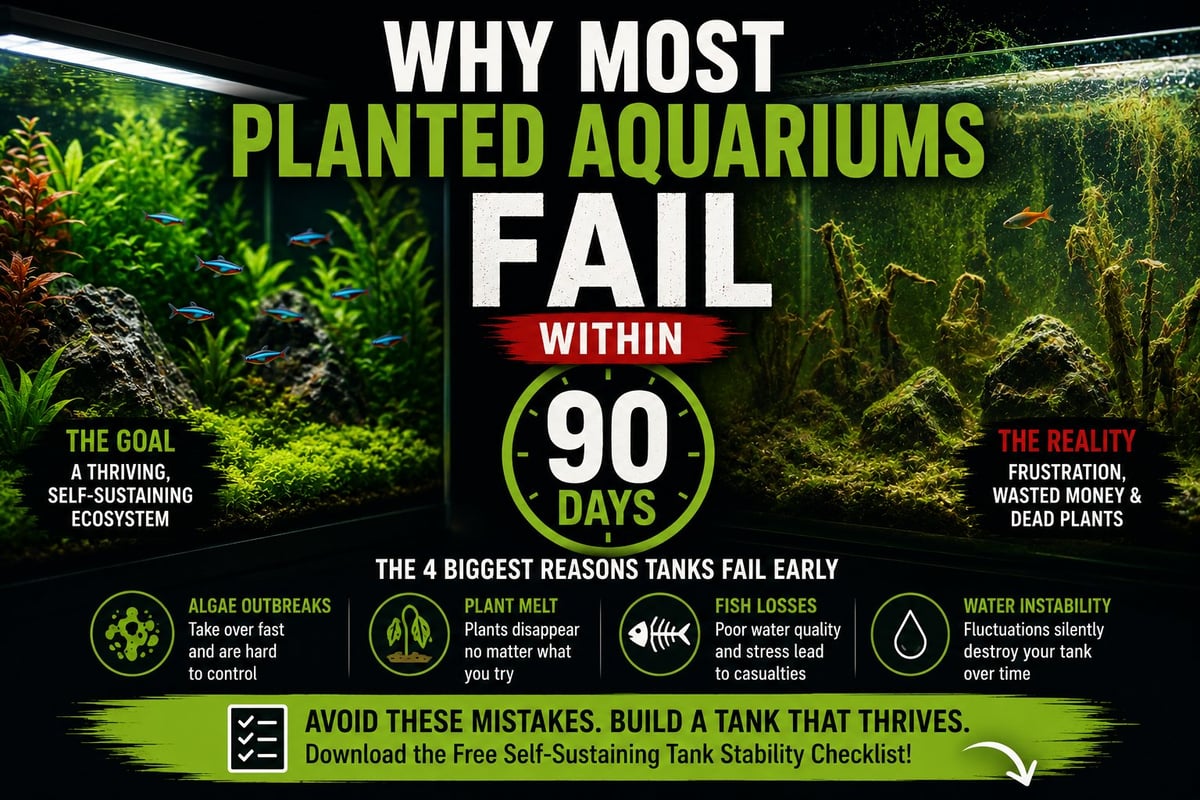
Many hobbyists encounter serious planted aquarium problems during the first 90 days. The truth is that most aquarium failures don't happen because people don't care enough. They happen because the ecosystem hasn't stabilized yet. We explore this in depth in our article on why 90% of planted tanks fail.
A planted aquarium is more than a glass box filled with water. It's a living ecosystem that needs time to establish balance between plants, beneficial bacteria, fish, lighting, nutrients, and water chemistry. When one piece falls out of balance, problems often appear quickly. That's why understanding the 9 ways hobbyists accidentally disrupt their aquarium ecosystem can make all the difference.
Many beginners assume that if the tank looks good during the first week, everything is fine. Unfortunately, most major issues don't show up until weeks later. If you're struggling with aquarium plants melting, you're not alone — and it doesn't always mean you've failed.
One of the most common planted aquarium problems is algae. A tank may look crystal clear during the first few weeks, only to suddenly develop:
Key insight: Algae isn't usually the root problem—it's a symptom that something in the ecosystem is out of balance. Many aquarists spend months fighting algae without realizing the actual cause started much earlier.
Nothing is more discouraging than watching healthy-looking plants slowly deteriorate. Leaves become transparent, yellow, brown, or begin falling apart altogether.
This phenomenon, often called "plant melt," catches many beginners off guard. In many cases, the plants weren't dying when you bought them. They were simply adjusting to completely different underwater conditions.
What you need to know: Without understanding what's happening, many hobbyists replace plants repeatedly while the underlying issue remains unresolved.
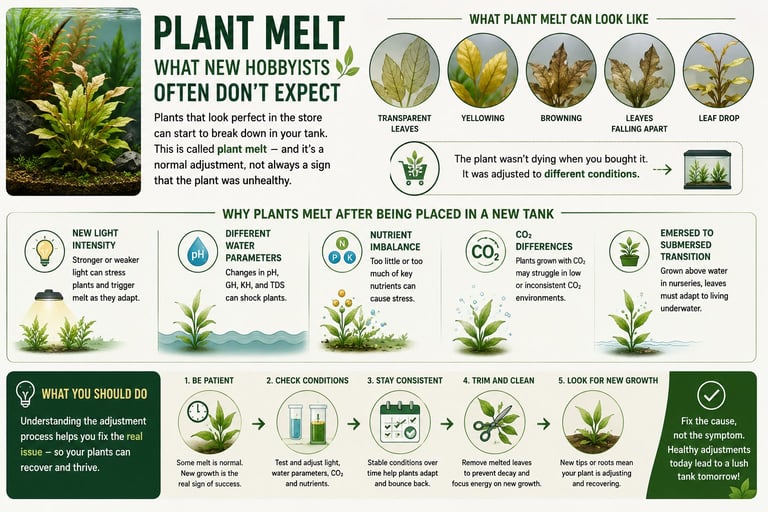
Click the infographic to expand
Don't wait for algae and plant melt to surprise you.
Get the free checklist that helps you spot these problems before they start.
Download Free Stability ChecklistFish rarely die without warning. Unfortunately, the warning signs are often difficult for new aquarium owners to recognize.
Fish may experience stress from conditions that aren't immediately obvious, including:
Unstable water parameters — fluctuations that stress fish over time
Sudden environmental changes — temperature swings, pH shifts
Immature biological filtration — the tank hasn't fully cycled
Poor ecosystem balance — too many fish, not enough plants
Critical reality: Because the water often looks clean, many people assume everything is healthy when hidden problems are developing beneath the surface.
Of all planted aquarium problems, water instability may be the most destructive. A planted aquarium can appear healthy one day and begin struggling the next because important water parameters fluctuate unexpectedly.
Small changes can create a chain reaction that affects:
Stunted or uneven development
Stress, disease, mortality
Disrupted nitrogen cycle
Explosive outbreaks
Most aquarium failures can be traced back to instability rather than a single catastrophic event. The challenge is that instability often develops gradually and remains unnoticed until visible symptoms appear.
"You can't troubleshoot your way out of a fundamentally unstable ecosystem. Stability is built from day one — not added later."
Build stability from day one.
Our free checklist walks you through the key stability factors most beginners miss.
Get the Free Stability ChecklistThe internet is full of conflicting advice. One source says add fertilizer. Another says stop fertilizing. One recommends more light. Another recommends less.
Without a clear framework, many aquarists end up chasing symptoms instead of understanding the bigger picture of ecosystem stability. This often leads to frustration, wasted money, and eventually giving up on planted aquariums altogether.
Most planted aquarium failures are preventable. The hobbyists who succeed long-term aren't necessarily more experienced—they simply avoid a handful of common mistakes during the critical first few months.
If you're planning a new planted tank or trying to stabilize an existing one, having a proven checklist can help you avoid many of the pitfalls that cause beginners to struggle.
Stop chasing symptoms. Start following a proven plan.
Download our free checklist and stop the cycle of frustration before it begins.
Grab Your Free ChecklistCommon questions about planted aquarium failures and how to prevent them
Learn what causes planted tanks to fail — and more importantly, how to prevent it
The honest truth about why most planted aquariums crash — and the systematic approach that prevents failure before it starts.
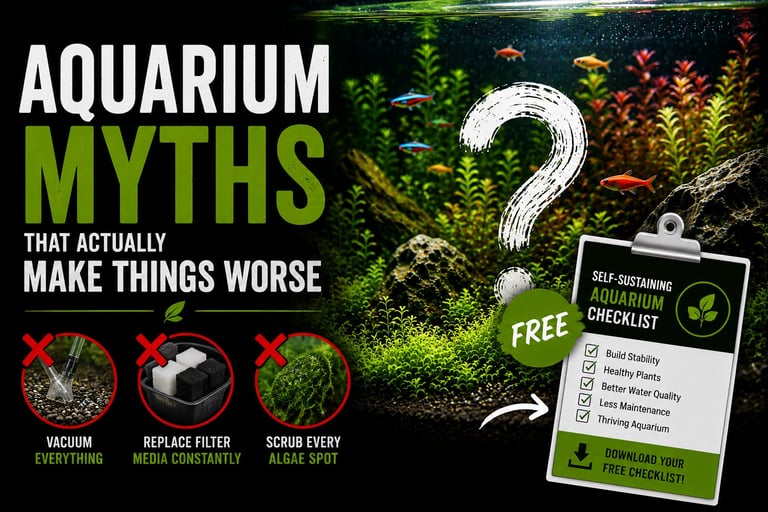
Many common "rules" lead to tank failure. Learn which popular advice may actually be sabotaging your planted aquarium.
Want to avoid the most common planted aquarium problems before they happen? Learn the key factors successful aquarists monitor during the first 90 days.
Prevent the errors that cause most tanks to fail
Stop chasing symptoms and understand the big picture
Create a stable ecosystem from day one
No spam. Unsubscribe anytime. Simple, actionable stability checklist.