Why Some Aquarium Owners Do Fewer Water Changes | Aquascape Oasis
Planted Aquarium Maintenance

Why Some Aquarium Owners Do Fewer Water Changes

The truth about plant density, biological filtration, and ecosystem maturity — and how they work together to reduce the need for frequent water changes in a planted aquarium.

Aquascape Oasis Team

Planted Tank Specialists

8 min read

The Goal Isn't Fewer Water Changes

For many aquarium hobbyists, weekly water changes are considered a non-negotiable part of tank maintenance. Every week, buckets come out. Gravel gets vacuumed. Water gets removed and replaced.

But if you've spent enough time in the planted aquarium community, you've probably noticed something interesting: some successful aquarium owners perform far fewer water changes than most people expect.

How is that possible? Are they neglecting their tanks? Are they simply taking risks?

Not necessarily. The answer often comes down to ecosystem design.

Successful aquarists don't build tanks with the goal of avoiding water changes. They build tanks with the goal of creating a stable ecosystem. As stability increases, maintenance requirements often decrease naturally. Fewer water changes are usually the result of a healthy ecosystem — not the objective itself.

1

Plant Density Plays a Bigger Role Than Most People Realize

One of the biggest differences between low-maintenance planted tanks and high-maintenance tanks is plant mass. Plants do much more than make an aquarium look beautiful.

They also interact with nutrients, fish waste, water chemistry, oxygen levels, and biological processes. A heavily planted aquarium often functions very differently than a sparsely planted tank.

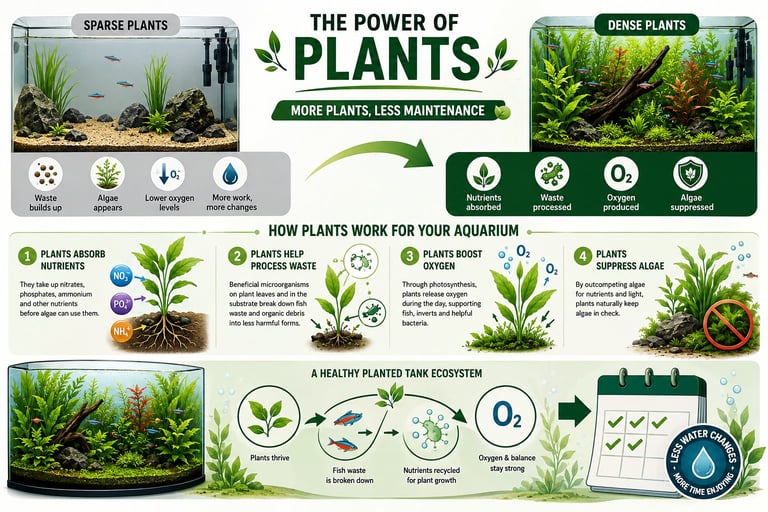
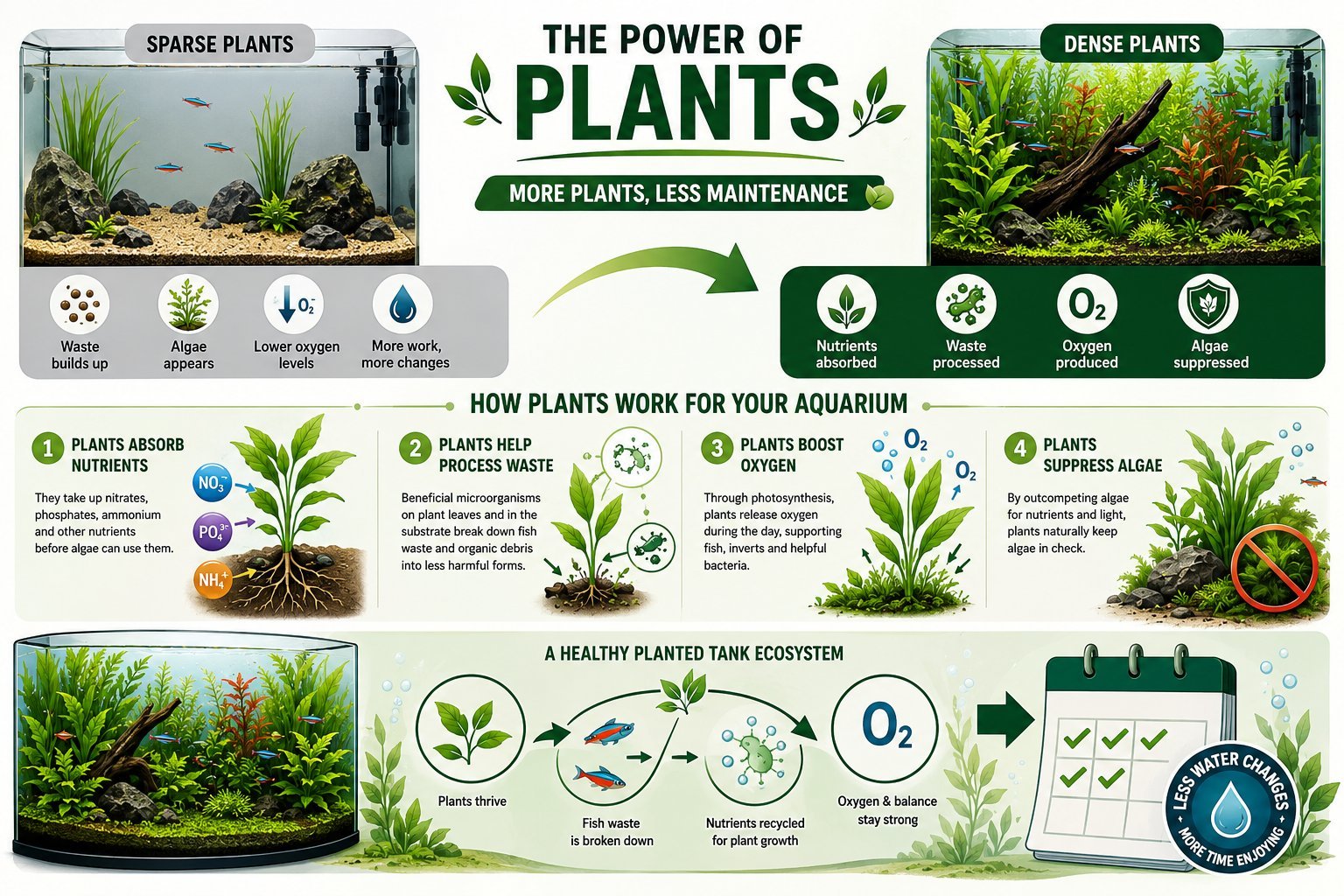
Nutrient absorption
Waste processing
Oxygen production
Algae suppression

As plant biomass increases, the ecosystem gains additional tools for maintaining balance. This is one reason many experienced aquascapers prioritize plant growth from the beginning.

Key insight: A densely planted tank isn't just aesthetically pleasing — it's a functional ecosystem where plants act as a natural filtration system, reducing the accumulation of compounds that would otherwise require water changes to remove.

Infographic showing the benefits of aquarium plants including sparse and dense plant types, how plants work in aquariums, and creating a healthy planted tank ecosystem.
Click to enlarge
2

Biological Filtration Does More Than Clean Water

Most aquarium owners understand that beneficial bacteria help process waste. What many don't realize is how important biological filtration becomes as an ecosystem matures.

Beneficial bacteria colonize filter media, substrate, hardscape, plant roots, and aquarium surfaces. Over time, these bacterial communities become increasingly established.

A mature biological filter can process waste far more efficiently than a newly established aquarium. This is one reason older, stable tanks often behave differently than newer setups.

What you need to know: Biological filtration is not just about the filter. It's about the entire ecosystem of bacteria that develops throughout the tank. This invisible network is what makes fewer water changes possible over time.

Want to understand what makes a planted tank self-sustaining?

Get the free checklist that helps you build a low-maintenance ecosystem from day one.

Download Free Self-Sustaining Tank Checklist
3

Ecosystem Maturity Changes Everything

Perhaps the most overlooked factor is ecosystem maturity. A tank that's three weeks old is not the same as a tank that's one year old.

As an aquarium matures, beneficial bacteria expand, plant root systems develop, microorganisms establish themselves, nutrient cycling becomes more consistent, and overall stability often improves.

Many of the issues that require frequent intervention in new aquariums become less common in mature systems. This doesn't mean mature tanks never need maintenance — it simply means the ecosystem often becomes more resilient.

Critical reality: A mature planted aquarium is fundamentally different from a new one. The biological processes that take months to develop are what ultimately allow for reduced maintenance. This can't be rushed.

4

Why New Tanks Usually Require More Attention

Many beginners hear about low-maintenance planted tanks and attempt to reduce water changes immediately. Unfortunately, this often creates problems.

New aquariums are still developing critical biological processes. During the first several months, the ecosystem is learning how to balance itself. This period often includes:

Algae outbreaks

Common during cycling phase

Plant adaptation

Transitioning to submerged growth

Parameter fluctuations

pH, ammonia, nitrite shifts

Biological instability

Immature bacterial colonies

Attempting to shortcut this stage can lead to frustration. Patience is often one of the most important ingredients in long-term aquarium success.

"A stable aquarium isn't built by avoiding maintenance. It's built by allowing the ecosystem enough time to establish itself fully — and that takes patience."

Patience is key — but so is a proven plan.

Our free checklist walks you through the key factors that help your tank mature into a self-sustaining ecosystem.

Get the Free Self-Sustaining Tank Checklist
Stability Matters More Than Schedules

Many aquarium owners become focused on rigid maintenance schedules. But successful planted tank keepers often pay closer attention to stability.

Instead of asking "How often should I change water?", they ask "How stable is my ecosystem?" Two aquariums of the same size can have completely different maintenance requirements depending on plant density, fish stocking levels, filtration capacity, tank maturity, and overall ecosystem balance.

This is why there is no universal water change schedule that works for every aquarium. Each tank is unique.

The Real Secret Is Balance

When people hear about aquarium owners performing fewer water changes, they often assume there's a shortcut. In reality, there usually isn't.

Most low-maintenance planted tanks are supported by multiple systems working together: healthy plants, strong biological filtration, stable water parameters, and a mature ecosystem. These factors combine to create an environment that requires less intervention over time.

What Most Beginners Get Wrong

Many hobbyists focus on individual techniques while ignoring overall ecosystem health. They look for the perfect filter, the perfect fertilizer, the perfect maintenance routine.

But long-term success often comes from understanding how all parts of the aquarium work together. The healthiest planted tanks aren't maintained through constant correction — they're built on stability from the start.

Stop chasing rigid schedules. Start building a self-sustaining ecosystem.

Download our free checklist and discover the key factors successful aquarists use to create self-sustaining planted tanks.

Grab Your Free Self-Sustaining Tank Checklist

Frequently Asked Questions

Common questions about water changes, plant density, and aquarium ecosystem stability

Download the Free Self-Sustaining Tank Checklist
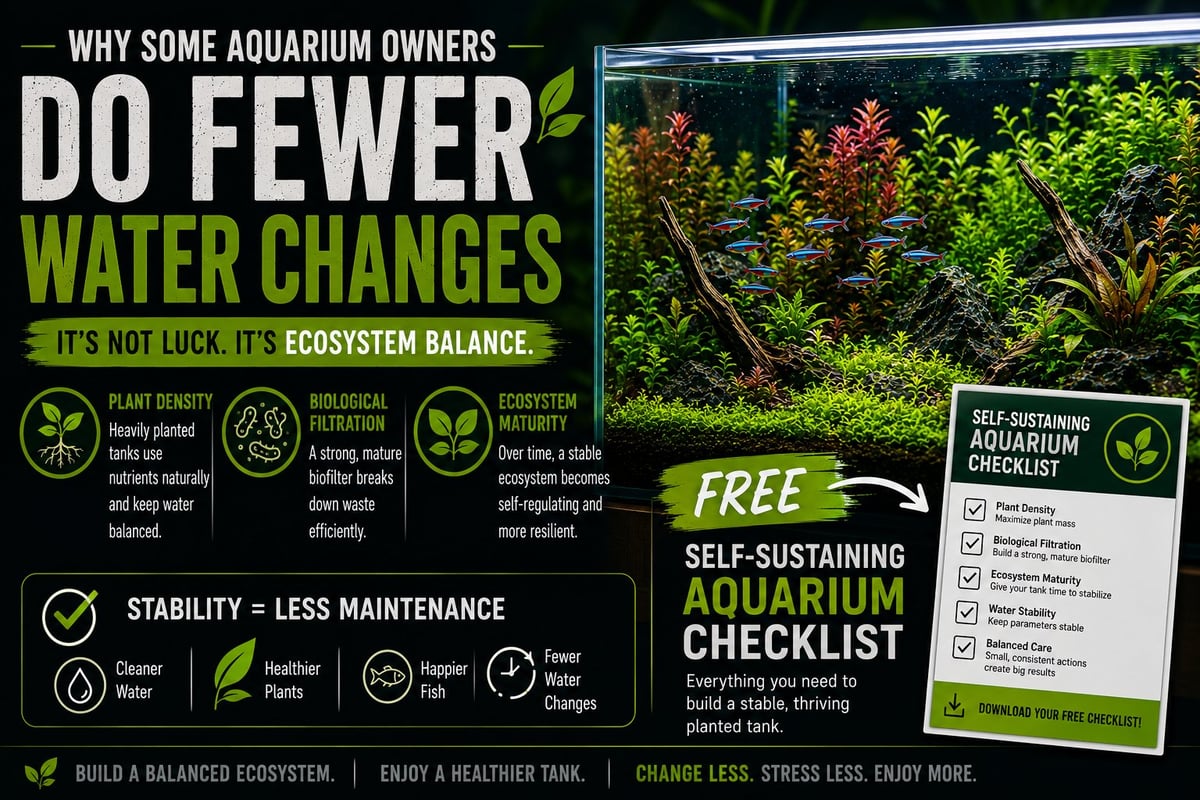
Want to learn the key factors that help successful aquarium owners build healthier, more self-sustaining planted tanks? Discover the critical areas experienced aquarists monitor when creating low-maintenance ecosystems.

Identify Hidden Issues

Spot common problems before they lead to algae, plant issues, or fish stress

Reduce Unnecessary Work

Understand when and why water changes are truly needed for your tank

Build a Self-Sustaining Tank

Create a balanced ecosystem that requires less intervention over time

Get Your Free Self-Sustaining Tank Checklist
No spam. Unsubscribe anytime. Simple, actionable self-sustaining tank checklist.